

What You'll Learn
Learning to respond to Google reviews the right way turns a single 2-star review from a crisis into the post that convinces a hesitant customer to book with you anyway. This guide walks through exactly what to do in the first ten minutes after a negative review lands, how to write a reply that doesn't sound defensive or robotic, and what a real response looks like for four different kinds of local businesses: a restaurant, a salon, a plumbing company, and a dental office.
You'll learn why trying to get the review removed is rarely your fastest or best move, how to acknowledge a specific complaint without admitting legal fault, when to take the conversation offline, and how to follow up once the problem is actually fixed. None of it requires a customer service background. It takes about fifteen minutes per review and a willingness to read the complaint twice before you start typing.
Why This Matters for Your Business
When a negative review shows up on your Google Business Profile, the first instinct for a lot of owners is to look for a way to make it disappear. Search "how to remove negative Google reviews" and you'll find a long list of services promising to do exactly that. The catch: Google only removes reviews that violate its policies, things like spam, hate speech, or a review left by someone who was never actually a customer. A review that's simply unflattering, even if you think it's unfair, almost always stays up.
That's not as bad as it sounds. New customers read your negative reviews on purpose, specifically to see how you handle them, before they ever read the five-star ones. A calm, specific reply to a 2-star review does more to earn trust than another generic "Thanks so much!" on a five-star one. It shows a real person is paying attention, and that whatever went wrong probably wouldn't happen to them.
The opposite is also true. A negative review with no reply, or a defensive one, tells the next customer something about you that you didn't intend to say: that you either don't notice when something goes wrong, or you don't handle it well when you do. Of the two, an unanswered review is usually the more common mistake, simply because most owners don't have a process for catching one the day it's posted.
Step 1: Pause and Read the Review Twice Before You Type Anything

The first read of a bad review almost always lands as an attack, even when it isn't one. Close the tab, make a coffee, do whatever you need to do, then come back and read it a second time looking specifically for the facts: what happened, when, and what the customer expected instead.
A review that says "Waited 45 minutes for a table we'd reserved, then got attitude when we asked about it" has two separate, fixable facts buried in one angry sentence: a reservation system that failed, and a staff interaction that made things worse. Responding to the tone of the review gets you nowhere. Responding to those two facts gives you somewhere to start.
If you manage the profile for more than one location, check which one the review is actually about before replying. A reply that mixes up your downtown shop with your location across town reads as careless to every customer who reads it afterward, including the one who left it.
Step 2: Respond to the Specific Problem, Not Just "We're Sorry"
"We're sorry you had a bad experience" is the line every customer has read a hundred times, and it reads as a copy-paste reply because it usually is one. Search "google review templates" and you'll find pages of this exact sentence with the blanks swapped out. The fix is small but it changes everything: name the actual thing that went wrong, in your own words, in the first sentence.
- Weak: "We're sorry you had a bad experience. We strive to provide great service to all our customers."
- Weak: "Thank you for your feedback. We will look into this."
- Specific: "I'm sorry your table wasn't ready at your reservation time on Saturday, and that the wait wasn't explained to you while it was happening."
- Specific: "I'm sorry the quote you got over the phone didn't match what you were charged at the end of the job."
Naming the specific problem does two things at once. It proves to the reviewer that you actually read what they wrote instead of skimming for the star rating, and it shows every future customer reading the thread that you know exactly where things broke down, which makes the rest of your reply easier to trust.
Step 3: Take Responsibility Without Admitting Legal Fault

For most local businesses, this step is simpler than it sounds: a missed reservation, a late technician, or a haircut that didn't match the reference photo isn't a legal exposure, it's a service miss, and you can own it plainly. "That's on us" or "We dropped the ball on this one" reads as confident, not weak.
It gets more delicate for businesses where a review touches on something with real liability, like a dental procedure, a home repair that may have caused damage, or anything involving an injury. In those cases, take responsibility for the experience and the communication around it, without admitting fault for the underlying outcome: "I'm sorry the recovery took longer than we discussed, and that you felt unprepared for that" addresses the customer's experience without conceding a clinical or legal point you haven't actually reviewed yet.
When in doubt, a short, warm reply that moves the conversation offline (Step 4) protects you far better than either a defensive non-apology or an over-promise you can't actually guarantee in writing.
Step 4: Move the Conversation Offline
Your public reply has one job: show every other reader that you handled this well. It is not the place to negotiate a refund, argue about what actually happened, or post a customer's invoice number. Close your public reply by inviting the reviewer to continue the conversation somewhere private: "Please call the shop directly at [number] or email [address] so we can make this right."
Giving a real name and a direct line, not just "contact us," matters more than it seems like it should. "Please reach out to Dana at the front desk" reads as a specific person willing to help. "Please contact our customer service team" reads as a form they'll never hear back from.
Most customers who get a fast, genuine offer to talk privately will take it, and quite a few will update their star rating afterward once the issue is actually resolved. That update is the real win. It doesn't erase the original review, but it adds a second, more recent line to the same thread that every future reader sees right alongside it.
Step 5: Write the Public Reply Customers Actually Read
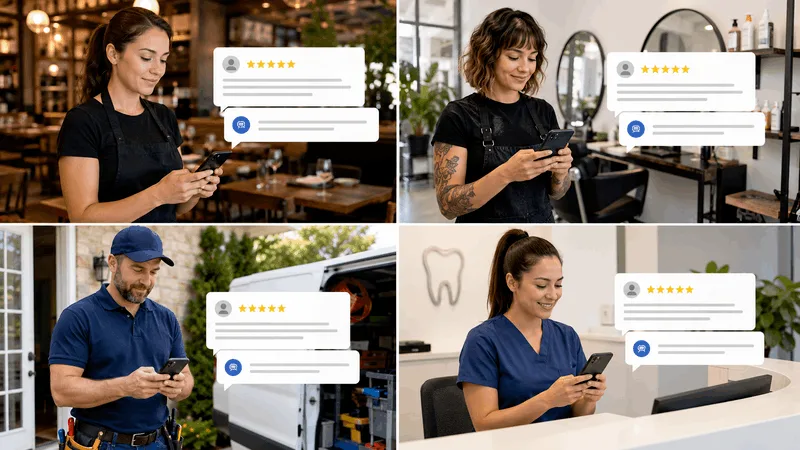
Here's what all four steps above look like put together, with real (lightly reworded) examples across four different kinds of local businesses. Notice that none of these are a fill-in-the-blank template: each one names the specific complaint, takes ownership in plain language, and gives a real way to continue the conversation.
| Business | What the Review Said | The Reply |
|---|---|---|
| Restaurant | "Reservation for 7pm, didn't get seated until almost 8. No one told us why." | "I'm sorry about the wait Saturday, and that no one came out to explain it while you were standing there. We had a larger party run long and should have let you know. Please ask for Marco next time you're in, dinner's on us." |
| Salon | "Asked for a few inches off, stylist took way more than I wanted." | "That's on us. A few inches should have meant a few inches, and I'm sorry it didn't match what you asked for. Please call the salon and ask for me directly, I'd like to fix this at no charge." |
| Plumber | "Quoted $150 over the phone, charged $310 after the job was done." | "I'm sorry the final price didn't match the quote you got over the phone. That's a breakdown on our end, not something you should have had to discover at checkout. Please call our office and ask for Dana, she can walk through the invoice with you and make it right." |
| Dentist | "Waited 40 minutes past my appointment time with no update." | "I'm sorry you were left waiting without an update, that's not how we want appointment time to go. We're adjusting our scheduling so the front desk checks in with anyone waiting past 10 minutes. Please call us so we can also make today's visit right." |
None of these replies argue with the reviewer, promise something the business can't control, or read like they were generated from the same google review responses template as every other reply on the profile. Each one is short enough to read in ten seconds and specific enough that it would still make sense to someone who never saw the original complaint.
Writing one of these from scratch every time a review comes in does take real effort, especially on a week when three reviews land at once. Tools like Clienzo can help here: its AI reply suggestions draft a first pass based on the specific review and your past responses, which you read, adjust to sound like you, and approve, rather than starting from a blank box every time.
Step 6: Follow Up After the Problem Is Actually Fixed
Replying fast matters, but the reply isn't the end of the process if the customer actually took you up on the private conversation. Once you've refunded the difference, redone the work, or explained what changed, send one short follow-up: "Just wanted to check in now that the new gutter's been installed, let us know if anything still doesn't look right."
This is also the moment a lot of customers will go back and update their star rating or add a comment, on their own, without being asked to. Don't ask directly for the rating to change; that can read as pressuring them and isn't something Google's guidelines look kindly on. Just close the loop on the actual problem and let the customer decide what they want to do with the review.
Keep a simple log, even just a spreadsheet, of which negative reviews you've resolved and how. Past a certain size, it's easy to lose track of who you promised to call back, and a customer who's still waiting two weeks later is angrier than the one who left the original review.
Common Mistakes to Avoid
- Replying while you're still angry. A defensive reply lives on your profile forever and is read by far more people than the customer you're arguing with.
- Posting customer details publicly. Invoice numbers, full names beyond what the reviewer already used, or details of a private conversation don't belong in a public reply.
- Offering a refund or discount in the public reply. It invites every future unhappy customer to leave a public review instead of calling you directly, since they've seen it works.
- Using the same three sentences on every negative review. Customers compare your replies across multiple reviews before they book, and a copy-pasted response undercuts the trust you're trying to build.
- Letting a review sit for weeks before replying. Speed reads as attentiveness. A reply that shows up a month later, after the customer has stopped checking, reads as an afterthought.
- Trying to get every negative review removed instead of responding to it. Google only removes reviews that break its policies, not ones that are simply unflattering, so most of your energy is better spent on the reply itself.